
Ivan Illich as Nature Activist

Given the controversial ‘Extinction Rebellion,’ it might seem reasonable to suppose that Ivan Illich might have supported this movement, given his criticism of the education industry along with the missionary industry, today that would include nonprofit and humanitarian NGOs, along with criticizing the medical industry, the water (treatment and recycling) industry, along with very saliently corporate claims of ‘energy equity.’
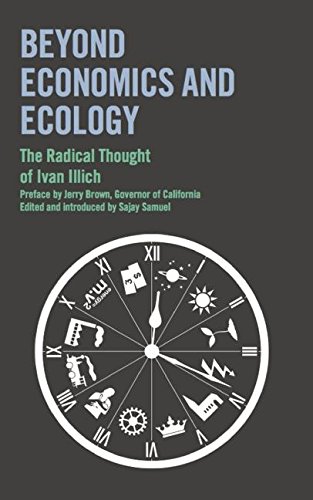
See the 2013 introduction by Sajay Samuel to Beyond Economics and Ecology.
Beyond Economics and Ecology: The Radical Thought of Ivan Illich
(London: Marion Boyars Publishers, 2013), 13-25
Hegelians and Marxists can seem dedicated to transforming so-called nature via as much technology as possible, insisting that nature natured (Spinoza), i.e., cultivated and transformed, is as ‘natural’ as anything in ‘free’ nature (Kant).

There are other examples, but my favorite is the argument offered by the BU trained philosopher, my erstwhile colleague, Steve Vogel, Against Nature.
Against Nature: The Concept of Nature in Critical Theory (Abany: SUNY, 1996)

Published three years after the first Earth Day in 1970, with his Tools for Conviviality, Illich seems to provide a manifesto for alternative movements, back to the land, some movements today called permaculture and so on. But such movements are short on memory, focusing only on the latest names, and given, think, with reference to Stanley Aronowitz’ “Winter of Our Discontent,” to activist burn out and activist despair that borders, beyond the arch irony of Aronowitz’ title, to something closer to a kind of ‘dark night,’ if one may so speak, of the social soul.[1]
It is not only the movements that are short on memory and some theorists are chary of reading Illich on technology, as he should always be read, together with Jacques Ellul’s sociological reflections (highlighting the complex) on technology and society.[2]
Other readings are both well articulated and useful (although arguably needing a reference to Günther Anders, as Illich himself might have referred to him as he might have referred quite as he likewise, non-reference has no limits, did not refer to Heidegger), such as Andreas Beinsteiner who summarizes Illich’s “declared aspiration” in Tools for Conviviality as
a methodology that enables diagnosing the perversion of means into ends: “My purpose is to lay down criteria by which the manipulation of people for the sake of their tools can be immediately recognized, and thus to exclude those artifacts and institutions which inevitably extinguish a convivial life style.” (27-8) His analysis emphasizes the tools themselves and not the intentions of the users; it is about the structure of tools and not the personality structure of those who use them. This is because of the consideration that tools enable a particular practice in the first place and thus also contribute to shaping a certain disposition or mentality.
Andreas Beinsteiner, “Conviviality, the Internet, and AI. Ivan Illich, Bernard Stiegler, and the Question Concerning Information-technological Self-limitation,” Open Cultural Studies 2020; Vol. 1: 131-142, here: 135.
If one needs Heidegger as a complement to both Illich and Stiegler and if Beinsteiner rightly brings in Shoshana Zuboff (herself without reference to Anders but making a point Anders had already made in 1956), to raise a question as Beinsteiner does
whether today’s digital networks are not precisely the domain where “demands” are “made by tools on people”, and where various (hyper)nudges are “fitting man to the service” of these tools – just the way Illich criticizes it about industrial tools (60). Shoshana Zuboff has suggested that the services of companies like Google or Facebook should not be understood as tools for the users, but rather as “means of behavioural modification” (82) offered to paying customers. Search requests, communication on “social networks” and location based services are only some of the sources that are employed to aggregate the vast amounts of data that fuel what Zuboff terms “surveillance capitalism” (75). More and more socially relevant decisions are made on algorithm-based processing of such data, and the people who are affected by these decisions hardly ever have the possibility of participating in the algorithm design.[4]

Still, and for many readers this might go without saying, one might suppose as he wrote on energy and equity and water that Illich would have had been on the side of fighting ‘climate change,’ just as the Pope himself has denounced those who ‘deny’ ‘climate change’ as ‘stupid.’ Otherwise, and this kind of distinction has served to distinguish positions in recent years, Illich would have to be on the denigrated side of the deniers, ranged with the no-sayers alongside Covid-denialists, AIDS-denialists, and anti-vaxxers opposed to ‘the science.’
The problem as Ellul, thinker of technological systems, would have pointed out, is ‘propaganda’ whereby I think it relevant to observe that it cannot but help, this is one of the several important reasons Illich did not fail to acknowledge Ellul as ‘Master,’[5] to have been, as Ellul was, a canon lawyer just to understand what is meant by propaganda.[6]
All that requires theology, sociology, theoretical and philosophical reflection on technology and science. And the subtleties of such fields can be, given today’s day of internet access and screen absorption, or screen autism, all too complicated.
Philosophically speaking, at issue is equivocation. Thus ‘nature’ requires historical context, ethnographic reflection, sociological nuance, and hermeneutics above all. To say this also means that we will need more than the kind of philosophy currently offered at most universities in the world. I have argued that we need Nietzsche’s philological hermeneutics quite to the level of reading truth and lie and raising the question of science as of language, along with Hans-Georg Gadamer, and Martin Heidegger and his reflections on language.
Just this framework is not Illich’s own (although, as I argue elsewhere, both Illich and Nietzsche were similarly concerned with the sound of ancient Greek, and Illich’s own teachers were in Nietzsche’s debt), as Illich draws on a different array of thinkers and traditions following his own formation in history (this is thus a matter of academic sociolinguistics and scholarly ethnography). I argue that the hermeneutic and phenomenological tradition can be a helpful complement to reading Illich as it is also a thought movement contemporary with his own work.
If nature is a complex question, so too is conviviality. And it seems that we need a reading of the kind Illich offered us, who unpacked the meaning of conspiracy. One such reading that takes its point of departure directly from Illich’s inspiration and follows his etymological lead, is on offer in Marianne Gronemeyer’s “Conviviality.”[7]
In an important and ‘tragic’ sense, given the current state of the world, to talk of the world, of ecology, of supposed ‘climate change’ — I say ‘supposed’ because a great deal is supposed in order to claim this (one is thinking after all in deep time, the time of epochs and our measures for what the climate has been in times past are nebulous at best — we have not had today’s standards for measuring the weather for more than a century or so, and past measures of course vary).
Thus, and Illich, a historian, would appreciate the point, the Viennese philosopher of science, two years younger than Illich, Paul Feyerabend (1924-1994), spoke of measure. This involves reference to a standard. Thus the standard for a meter was set in 1799 and nearly a hundred years later the prototype bar was changed, metal having susceptibilities to ambient air over time, and then and now today it is defined as a certain number of wavelengths of a certain emission line of Krypton 86 (sounds very Superman) but that too has continued to change.

All such terms, like the late Bruno Latour’s (1947-2022) efforts to talk about ‘Gaia,’ are profoundly equivocal and scholars tend to receive such reflections in terms of their own research. Thus the rhetoric of ‘sustainability’ can be taken to match Illich’s conception of conviviality on the level of resources (though there we already have the philosopher’s famous ‘slippery slope’) including the language of renewability, replaced by modern capitalist rhetoric with the concept of carbon offsets, etc. Thus, it is imagined using a practice, as old as agriculture, that one can simply replace the plant one harvests, that one might cultivate a garden, as one can replace the egg one eats by raising chickens, given that one rears animals, in whatever conditions bucolic and alluring or as is mostly the case and has nearly always been the case, more brutally than not, all the way to industrial agrobusiness, for consumption.
There is a great deal of reading and research needed here to talk about what is involved with cultivation as all gardening, farming, industrial or not, takes a toll. The fruit eaten is not, technically, ‘replaced’ as much as it is consumed, that is to say lost: rind and seeds, waste and all, including reserved seeds for later planting. What is then planted is also ‘lost,’ as some seeds germinate (there is a lovely gospel allusion here) and some do not and those that do require care to grow and time to bear fruit. For the sake of agriculture, a well-established culture (practical and historical knowledge, a social order) is already required one that perhaps, like certain north American native peoples before Columbus, would plant but also gather and who would follow animals and even the productivity of the harvest by walking.
In the United States it was sufficient for the government, i.e., dedicated for financial reasons to ‘conquering the West,’ to slaughter buffalo systematically and wholesale over a few years in order, this was the calculation, to starve the Indians who depended on them and had the habit of moving constantly in ways inconducive to European concepts of static propriety and property ownership. A perfect genocide.
Elsewhere I point to the highly processed character of vegan substitute ersatz burgers and cheeses. But even the high tech ideal of ultra-processed, ‘lab-grown meat’ requires the cognitive dissonance not of the idea but the technical inattention to details required to petri-dish ‘grow’ the raw materials for such ‘lab grown’ meat to begin with. For lab grown meat to be cultured, one needs fetal bovine serum, that is, to quote one journalist, “the blood of unborn cow fetuses, extracted from their mothers after slaughter.”[8]
Similarly equivocal free association can let one imagining that sustainably ‘farmed’ salmon might be somehow a good thing rather than inherently risky, owing to cancer risks and other issues.[9]

One might remark, reading Deschooling Society[10], on Illich’s reflection on Karl Marx who, as Illich tells his reader can be confounding to those who wish to be in his thrall but find his policies complicated and given their breadth more than supposed (Marx being, author of ten volumes of Capital, a particularly good example of the point). In context, Illich is talking about how calls for reform, including his own, are understood and interpreted by those who propose such calls and by those who hear such calls. At issue was of course Illich’s sense that his readers would be missing his point (nor was he wrong) about school/deschooling, related as this was, again: Illich was a historian, to his recollection of the recent invention of ‘childhood’ as such and the imposition onto children of a distinct form of non-participation in the life of full maturity, including the capacity as Kant spoke of this of speaking in one’s own voice, Mündigkeit and to that extent cultivation and self-determination. Thus just before beginning a chapter on the phenomenology of school, a chapter largely unread by phenomenologically-minded scholars who write on education, Illich highlighted, qua dissonant to some of Marx’s supporters,
the resistance which Karl Marx put up against a passage in the Gotha program which-one hundred years ago wanted to outlaw child labor. He opposed the proposal in the interest of the education of the young, which could happen only at work. If the greatest fruit of man’s labor should be the education he receives from it and the opportunity which work gives him to initiate the education of others, then the alienation of modern society in a pedagogical sense is even worse than its economic alienation.[11]
A similar observation more salient on the theme of the current political reception of ‘climate change.’ The project of ‘supporting’ the earth, was named for a “whole earth movement,” which led in various expressions to things as broad and literal as a Whole Earth Catalogue, an ethos of drop outs, language familiar to readers of Illich and those of a certain ecological sensibility, green political and social thematics along with a very under-theorized and under-discussed attention to the greenwashing that went along, from the very beginning Earth Day 1 May 1970, for example, sparked that very same Whole Earth Catalogue, an actual catalogue, selling items and so thoroughly commerce minded, like the consumerist Sears Roebuck catalogue in the USA. The economy makes all the difference.[12] And it can seem that everything, especially the green-themed, is for sale.
Above I noted, although he remains unfamiliar in an Anglophone context,[13] Robert Kurz who highlights the contradiction for Marxist mindset theorists thinking about capitalism which seems to have, like the joke about Wagner and Wagnerians, no end.

Kurz had argued that we constantly bail out capitalism as a failed system, as it is, as ideal, as political and economic concept. Today it may be argued that this is even more true than in his life-time — Kurz died a decade after Illich — as our economic system is propped up by contrived panics, pandemics, wars, all of it all-too-‘real’ almost, were it not banal, in Jacques Lacan’s sense of the Real.
It is as if we cannot bear the thought that our most beloved economic system, oddly identified in the popular mindset, thanks to Adam Smith and certain invisible vagaries, with ‘freedom,’ might have defects. Thus we name capitalism ‘democratic’ as if this were (or could ever be) ‘true’ — what on earth would that mean, the entire point of capitalism being to kip the market to one’s best advantage towards the effective and ongoing impoverishment of others including one’s competitors, one’s workers, and one’s marks (call them ‘consumers’), i.e., the system is dedicated to gaining economic advantage via the (ignored or disattended) disenfranchisement of others.
To avoid suspicion of weakness in the system we perpetuate it despite, as Kurz analyses this, its ongoing refutation, thus throwing good tax (meaning public) funds after bad private losses, which (of course) amounts to a transfer of “the commons,” as this exists variously including mineral rights and land grabs, funneling wealth, formerly publicly accessible, like the former accessibility of water and building material and fuel for cooking as Illich discusses this as formerly freely available in Mexico and South America for centuries circumscribed conduits with clearly defined bills to paid, and that is to say that these formerly accessible resources are now funneled through the hands of a few.
What commentators do say that is repeated in the media (as if it were or could be ‘true’) is that these few—always described, in an irony that would not have surprised Marx, as ‘job creators’—may be expected to give back to the community in spades. But this, as Illich points out, is circular.
When the same ‘jobs’ are not forthcoming and, increasingly they are not, i.e., when wage slaves are denied the opportunity to be wage slaves, or to make enough to pay their rent, which as rents increase is currently an issue, commentators argue that the problem is that insufficient public funds were made available for the purpose whereby, as the logic of imperialistic reason holds, the only solution is to transfer yet more public funds to private fortunes. And so we do.
It is in this same spirit of eternal survivability or recurrence, that Kurz reprises his own argument on the collapse of capitalism followed by the eternal return of the same, in his study of the “collapse of modernity.”[14] For Kurz, in a biting formulation, exact and unpleasant and empirical as it is impoverishment is the effect of the market economy, the play is on the terrible slogan of the Nazi concentration camps which were conceived, no mistake, as labor camps, thus the socialism in National Socialism, Arbeit macht frei: “Marktwirtschaft macht arm.“ [15]
At issue for Kurz, and he speaks about this presciently will be wars of and for the new world order, in what he calls the ‘age of globalization.’[16] Note, to use Kurz’s metaphor, that capitalism is again and again reborn of its own ashes, using the messianic language ‘money goes to heaven.’[17]
Reading Illich on economics can help us read Heidegger’s mid-century reflection on technology, with its economic metaphors in The Question Concerning Technology: like, standing reserve, challenging revealing, Ge-Stell, etc.[18] As Illich writes in Tools for Conviviality: “The building trades are another example of an industry that modern nation-states impose on their societies, thereby modernizing the poverty of their citizens.”[19] As Illich observes,
The pretense of a society to provide ever better housing is the same kind of aberration we have met in the pretense of doctors to provide better health and of engineers to provide higher speeds. The setting of abstract impossible goals turns the means by which these are to be achieved into ends.[20]
Illich, whose enthusiasm for the bicycle and not less and perhaps still more importantly, for walking is well-known, also emphasized the importance of scale when it came not only to innovations to one’s own dwelling (not ‘permitted’) but to power tools, reminding us that
In a modern society, energy inputs represent one of the major new liberties. Each man’s ability to produce change depends on his ability to control low-entropy energy. On this control of energy depends his right to give his meaning to the physical environment. His ability to act toward the future depends on his control of the energy that gives shape to that future. Equal freedom in a society that uses large amounts of environmental energy means equal control over the transformation of that energy and not just an equal claim to what has been done with it.[21]
If I already noted that it is necessary to acknowledge Illich’s complicated language of ‘conviviality,’ any reflection on nature requires that we heed his caution at the level of the word, once again, concerning the language of what is considered ‘better’ in assessing measures of progress or well-being:
“People get better education, better health, better transportation, better entertainment, and often even better nourishment only if the experts’ goals are taken as the measurement of what ’better’ means.”[22]
Thus in his own reflection on the famous crisis of the commons, the political economist, Sajay Samuel takes care to clarify, and this should be compared with some of the arguments made in another context by Vandana Shiva, as Sajay uses Illichian language on language, quite as a matter, as Nietzsche also argued, of ‘what things are called’:
The widespread belief that economic growth comes at the cost of ecological despoliation overlooks the more decisive and prior destruction of the socio-cultural milieu of a people; the vernacular. For this reason Illich wrote in Silence is a Commons that the most virulent kind of ecological degradation occurs with “the transformation of the environment from a commons to a productive resource.” It is not just that land then becomes real estate, viewed from a distance rather than trodden underfoot. Rather, economic values proliferate by engulfing the variegated ways of living in common, a kind of destruction reflected sharply in the steady vanishing of languages.[23]
Not carbon offsets or credits, as if this were a balance book or indeed digital scoring systems as if AI might aid us, but only a transformation of spirit is required. We cannot keep the same economic system, the same culture and expect transformation.
Rather than speaking of climate change we need to change the way we live. Thus Illich focused on tools, medical institutions, schools, our way of living and being one with another. Here Illich is uncompromising throughout his work, as he writes before he moves into a reflection on the meaning of equilibrium (no less crucial in riding a bike or handing certain tools) and it will do to emphasize the point: “only the renunciation of industrial expansion can bring food and population into a balance in the so-called backward countries.”[24] But the same is true would hold for so-called advanced countries, perhaps even more so as the same issue, the same question of balance holds everywhere human beings find themselves.
Illich argued, and this makes him a complicated thinker for the philosophy of technology, that industrial development, that is modern technology, is the problem not the solution. Hence, and here Illich concurs with Jacques Ellul from whom he learned so much (the amount of citation does not give an index of this dependency — Illich was aware of Ellul as one of the few thinkers who dared to criticize technology precisely in systematic terms) industrial development by its nature, as Ellul shows in book after book, cannot be tweaked or retooled to become the solution. The issue, as Anders argued in middle of the last century in his The Antiquatedness of Humanity, is our competitive identification with (Anders called this our Promethean ‘shame’ in the face of the things we have made) and thereby our ressentiment towards those things (call them tools, gadgets, technologies, AI, as you like).[25] This is also our tendency to mirror our tools (etc.) in the age of what Illich called ‘the show.’[26]
The focus on industry, the focus on technocratic solutions blinds us to the pervasiveness of the problem, nowhere more so than in the case of nature or the environment, thus beginning with an example that comes straight out of the Catch 22 associated with atomic energy, as Illich argues with respect to waste, especially nuclear waste, a problem that has not been solved even if nations simply decide to build more reactors[27] — or pollution in general:
The environmental crisis, for example, is rendered superficial if it is not pointed out that antipollution devices can only be effective if the total output of production decreases. Otherwise they tend to shift garbage out of sight, push it into the future, or dump it onto the poor. The total removal of the pollution created locally by a large-scale industry requires equipment, material, and energy that can create several times the damage elsewhere. Making antipollution devices compulsory only increases the unit cost of the product. This may conserve some fresh air for all, because fewer people can afford to drive cars or sleep in air-conditioned homes or fly to a fishing ground on the weekend, but it replaces damage to the physical environment with further social disintegration.[28]
Illich explains the problem in more detail than many care to consider thus reviewing the anti-life arguments of Paul Ehrlich (as in the interval what is wanted is eugenics, not mere birth control but negative population growth, an old argument dating backing before Malthus), arguing the general importance of inversion across the board of technologies as well as our reliance on them, as Illich reminds us,
“Fascination with the environmental crisis has forced the debate about survival to focus on only one balance threatened by tools.”[29]
For Illich, and here we can see at least one reason for the title Tools for Conviviality, the path towards a possible solution is also the one that we continue to find confounding:
The only solution to the environmental crisis is the shared insight of people that they would be happier if they could work together and care for each other. Such an inversion of the current world view requires intellectual courage for it exposes us to the unenlightened yet painful criticism of being not only antipeople and against economic progress, but equally against liberal education and scientific and technological advance.
Thus the holy one of the gospels recommends: love one another. But that’s the trouble. Schopenhauer had compared us to hedgehogs who indeed require one another but can only, given their prickly nature, impinge on one another. Our current preoccupation with our screens and the narrow circles of our lives suggests that we might pay attention to Schopenhauer, as the stimulation of consciousness and ego has never been more efficiently manipulated such that we are all, more or less, inevitably intruding on one another. Thus tactically, practically for Illich, just assuming we want something like ‘conviviality’, we
must face the fact that the imbalance between man and the environment is just one of several mutually reinforcing stresses, each distorting the balance of life in a different dimension. In this view, overpopulation is the result of a distortion in the balance of learning, dependence on affluence is the result of a radical monopoly of institutional over personal values, and faulty technology is inexorably consequent upon a transformation of means into ends.[30]
For Illich, there is no alternative to this option, however daunting a project this would be —requiring, presupposing a path to a certain spirituality currently lacking if it was ever present — and the beautiful In the Vineyard of the Text offers an ideal vision of (and context for) a monastic possibility for such a way of living — and Illich uses the language of French existentialism married to Max Weber: “Otherwise man will find himself totally enclosed within his artificial creation, with no exit.”[31] Here there is the lurking prospect of technological gnosis:
“Enveloped in a physical, social, and psychological milieu of his own making, he will be a prisoner in the shell of technology, unable to find again the ancient milieu to which he was adapted for hundreds of thousands of years.” [32]
[1] This had set in already in the 1960s, where Illich himself could cite Philip Larkin’s poem to the rueful FOMA of the age (complete with the Beatles and Lady Chatterley’s Lover), and as one can see in the case of the sardonic insights of Tom Lehrer’s Folk Song Army.
[2] An insightful exception is Savannah Anne Carman’s 2021 essay published by The Center for Bioethics & Human Dignity, “Ivan Illich on the Convivial & Industrial Society,” Dignitas, Vol. 28, no. 3–4 (2021): 8-11.
[3] Andreas Beinsteiner, “Conviviality, the Internet, and AI. Ivan Illich, Bernard Stiegler, and the Question Concerning Information-technological Self-limitation,” Open Cultural Studies 2020; Vol. 1: 131-142, here: 135.
[4] Beinsteiner, “Conviviality, the Internet, and AI,” 139. Citing Richard Thaler, Richard H., and Cass R. Sunstein. 2008. Nudge. Improving Decisions About Health, Wealth, and Happiness (Yale University Press, 2008 and Karen Yeung, Karen. 2017. “‘Hypernudge’: Big Data as a Mode of Regulation by Design,” Information Communication and Society, Vol. 20, no. 1, 2017, 118-136, now often simply gathered under the rubric of the ‘algorithm,’ and the author of Surveillance Capitalism, Shoshana Zuboff, 2015 “Big other: Surveillance Capitalism and the Prospects of an Information Civilization,” Journal of Information Technology, Vol. 30, no. 1, 75-89.
[5] Ivan Illich, “To Honor Jacques Ellul,” November 13, 1993, 3: https://www.davidtinapple.com/illich/1993_honor_ellul.PDF.
[6] Jacques Ellul, Propaganda: The Formation of Men’s Attitudes, Konrad Kellen and Jean Lerner, trans. (New York: Vintage, 1973, 1965 [1962]).
[7] Marianne Gronemeyer, 2015. “Conviviality” in: David Bollier & Silke Helfrich, eds., Patterns of Commoning html (Off the Common Books, 2015). Online: https://patternsofcommoning.org/conviviality/.
[8] Tom Philpott, “The Bloody Secret Behind Lab-Grown Meat: Maybe we can’t have our steak and eat it guilt-free, too, Mother Jones, 3/ 2022. Online: https://www.motherjones.com/environment/2022/03/lab-meat-fetal-bovine-serum-blood-slaughter-cultured/.
[9] Thus a 2004 report instantly invited push back from scientists in the pay of the fish farming industry, yet the authors and others two years later revised their statements to recommend consuming such farmed salmon at most once every five months to reduce health risks. Xiaoyu Huang, et al., “Consumption Advisories for Salmon Based on Risk of Cancer and Noncancer Health Effects,” Environ Res, Vol. 101, No. 2 (2006 Jun): 263-274.
[10] Ivan Illich, Deschooling Society (London: Marion Boyars Publishers Ltd., 2000).
[11] Illich, Deschooling Society, 12.
[12] See with specific sociological and historical reference to the US, the sociologist, Stanley Aronowitz’ “The Winter of Our Discontent,” Situations: Project of the Radical Imagination, Vol. IV, No. II (2012): 37-76.
[13] By contrast, available in French: Robert Kurz, Vie et mort du capitalisme (Paris: by Editions Lignes, 2011). See too Kurz, „Kapital und Geschichte“ in: Neues Deutschland, April, 24, 2009.
[14] Robert Kurz, Der Kollaps der Modernisierung (Leipzig: Reclam, 1994 [1991]).
[15] Kurz, Schwarzbuch Kapitalismus. Ein Abgesang auf die Marktwirtschaft (Eichborn: Ullstein Taschenbuch, 2009 [1990]).
[16] Kurz, Weltordnungskrieg: Das Ende der Souveränität und die Wandlungen des Imperialismus im
Zeitalter der Globalisierung (Berlin: Horlemann, 2003). For Kurz, “the word collapse is a provocative cliché, and is generally used in a pejorative sense, so that the representatives of radical crisis theory can discredit someone by implying that they should not be taken seriously. Not only the capitalist elites, but also the representatives of the left, prefer to believe that capitalism is capable of eternal self-renewal/” Kurz, here in a 2009 interview with IHU online. http://libcom.org/library/2009-interview-ihu-online-robert-kurz.
[17] Kurz, “Die Himmelfahrt des Geldes. Strukturelle Schranken der Kapitalverwertung, Kasinokapitalismus und globale Finanzkrise,” Krisis 16/17 (1995): 21-76.
[18] But see the discussion paper by Hans-Jörg Beilharz, „Wirtschaft, Technik und der Herausfordernde Anspruch des Klimawandels – Eine philosophische Betrachtung zu den Wurzeln des Anthropogenen Klimawandels,“ IUBH Discussion Papers, Reihe: Business & Management, Vol. 3, Issue 11 (Sept. 2020): 1-15 as well as, in English, an unpublished dissertation, Gerry Stahl, Marxian Hermeneutics and Heideggerian Social Theory: Interpreting and Transforming Our World (Purdue University, 1975. Ph.D., Diss). as well as and including a titular reference to Heidegger on technology, Frank Schalow, “Heidegger and the Question of Economics,” American Catholic Philosophical Quarterly, Vol. 74, Issue 2 (Spring 2000): 249-267 as well as Trish Glazebrook, “Heidegger and Economics: Withdrawal of Being In Capital,” New Ways of Contextualizing Heidegger along with my several discussions of Heidegger, economics and technology, including, with reference to Illich, “Tools for Subversion.”
[19] Illich, Tools for Conviviality, 48.
[20] Illich, Tools for Conviviality, 50.
[21] Illich, Tools for Conviviality, 52.
[22] Illich, Tools for Conviviality, 53.
[23] Sajay, “Introduction,” 17.
[24] Illich, Tools for Conviviality, 55.
[25] See for discussion, Babich, Günther Anders’ Philosophy of Technology (London: Bloomsbury, 2023 [2022]).
[26] Illich, “Guarding the Eye in the Age of Show,” RES: Anthropology and Aesthetics, No. 28 (Autumn, 1995): 47-61 and cf., in the context of Medical Nemesis, Babich, “Ivan Illich’s Medical Nemesis and the ‘age of the show’: On the Expropriation of Death,” Nurs Philos, Vol. 19/1 (Jan 2018): 1-13.
[27] Orrin H. Pilkey and Linda Pilkey-Jarvis, “Yucca Mountain: A Million Years of Certainty” in Useless Arithmetic: Why Environmental Scientists Can’t Predict the Future (New York: Columbia University, 2007), 45-65.
[28] Illich, Tools for Conviviality, 57.
[29] Illich, Tools for Conviviality, 59.
[30] Illich, Tools for Conviviality, 60.
[31] Illich, Tools for Conviviality, 61.
[32] Illich, Tools for Conviviality, 61.
 Babette Babich
Wide ranging and full of points to discuss further (as usual with you)
Thanks for this reflection.
This represents part of my contribution composed for the meeting in Friesenheim (along with photos of the first full day of the three day event.
See too the contributions that appeared in the 2024 issue of Conspiratio: https://thinkingwithivanillich.net/wp-content/uploads/2023/06/Conspiratio_Issue-6-_Fall-2024-r.pdf