
Being an excerpt of a text currently available behind a paywall1
Go get yourself a culture, only then will you find out what philosophy can and will do.
— Nietzsche
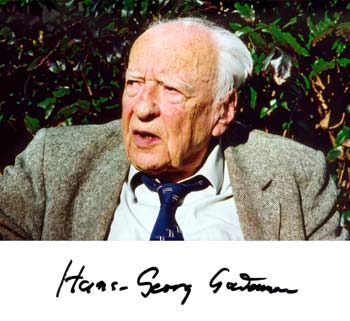
Hans-Georg Gadamer (1900-2002) wrote about prejudice and the importance of critique, that is: being oneself exposed, personally, to challenge. For Gadamer this explicitly included an opposition to mass media in the mid-1980s and not less, as he made this notion of critical thinking explicit, questioning official truth narratives.
Speaking on “the idea of the university,” at the University of Heidelberg, Gadamer reminded his audience that “inquiry and research produces poor television viewers and newspaper readers.” 2
The claim requires its own hermeneutic, here to be heard in the German context where the standard of education, at least at a popular level, is the ability to read the newspaper with a certain dedication.
If today we worry more about ‘fake news’ and find scholars advocating for the uncritical acceptance of ‘official’ sources, for Gadamer, hermeneutically speaking:
We always ask: what is the motivation? What interests are being expressed? Why are we being informed about this? Is the aim to keep us within the limits of an administered social order?3
In addition to this critical emphasis, Gadamer reminded his audience that the university is exactly not a preparation for everyday life. Thus and very traditionally, “persons having received a theoretical training are often disappointed when they have to face practical life.”4
‘Disappointed’ would be putting it mildly.
The theoretical ideal here was Wilhelm Humboldt’s sense of the university and culture,5 and in this Gadamer articulates the free ideal of the so-called ‘liberal’ arts, just as many Anglophone readers might cite John Henry Cardinal Newman and Alasdair MacIntyre on the ‘very idea of the university.’6 For his part, Gadamer writes in the German tradition which is to say that he writes about Bildung, i.e., culture and cultivation, a word effectively untranslatable especially if translated as education, more technically: Erziehung,7 and a bit less, but in the same context, qua professional or trade formation, Ausbildung.8
Here I argue that Gadamer’s thinking on education, classical as it was, might be productively compared with Ivan Illich (1926-2002). Both thinkers were concerned with language and history, as one might expect in the case of Gadamer, a classicist and Illich, a historian, if Gadamer’s reflections on education might seem to have little in common with the contrarian author of Deschooling Society.9 Gadamer was a university professor, who taught at universities all his life where, by contrast, as Illich emphasized, Illich was ‘associated’ with universities, apart from a short-lived (and conflicted) position as vice-rector of the Catholic University of Puerto Rico, connected with Fordham and the University of Bremen and Hagen, and with teaching at Penn State, Illich was not a ‘professor’ per se and where Illich remained a Catholic and, despite rumours to the contrary, an ordained priest all his life, quite where Gadamer was a perfect ‘Protestant,’ Illich was a ‘perfect’ iconoclast.
Ivan Illich and Hermeneutics
I read Illich in concert with hermeneutics yet it can be argued that hermeneutics is fairly limited to Gadamer and Ricoeur (and others less discussed). Here the point would be that it might seem that there are sufficient divergences between Gadamer and Ricoeur. In addition, hermeneutics is multifarious, as any survey article will attest, including a number of alternate and sometimes disparate hermeneutic traditions.10 Nevertheless, just as Gadamer cites Husserl with respect to phenomenology when it comes to authority/tradition:
Phenomenology: that is I and Heidegger, and no one else.11
And, if absent Husserl’s self-reference, the present author would argue that Gadamer and Heidegger exemplify hermeneutics, there is a hermeneutic breadth that takes a step back to include Nietzsche if only for the sake of his 19th century context in classical philology on the reception and reading of ancient texts.12 It is in this framework that the case for hermeneutics can be made for Ivan Illich,13 especially with respect to his discussion of Hugh of St. Victor and not less Illich’s innovative, bodily articulation of textual-locative readerly hermeneutics.
The argument for reading Illich in connection with hermeneutics and education has been made explicitly,14 thus early responses to Illich’s Medical Nemesis highlighted parallels with hermeneutics in Gadamer and Ricoeur.15 But, and again, hermeneutic analyses of Illich remain rare when it comes to education. The point is hardly that Illich is ‘unknown.’ Almost everyone knows or else supposes that they know what Illich writes on ‘deschooling society.’ Yet engagement seems to end at the title and the substance of his argument is excluded in advance as scholars bristle at the idea of ‘deschooling’ or ‘disestablishing school’ at any level.
David Gabbard has explored this issue with a hermeneutic shift to Foucault’s language of ‘discourse.’ Thus, for Gabbard, although classically philological perspectives on the tradition of ‘commentary’ might disagree with the expression as articulated, “[i]nsofar as it speaks the never-before-said of an already-said, a commentary poses as a definitive restatement of some primary discourse.”16 Here we might recall Gadamer for hermeneutic nuance when he writes about the challenge of “learning to speak” — reminding us of the relative “genius of the three year old” as Gadamer puts it, as he might have echoed Piaget — any time we undertake any effort whatever at ‘translation’
we are familiar with the strange, uncomfortable, and torturous feeling we have as long as we do not have the right word. When we have found it the right expression (it need not always be one word), when we are certain that we have it, then it “stands,” something has come to a “stand.” Once again we have have a halt in the midst of the rush of a the foreign language, whose endless variation makes us lose our orientation. What I am describing is the mode of the whole human experience of the world.17
The context for Gadamer’s 1966 reflection recalls his earlier, Truth and Method as well as his lifelong engagement with Heidegger’s reflections on hermeneutic phenomenology. Indeed in his 1942 lecture course on Hölderlin’s Ister, it is worth underlining the fairly blunt force of Heidegger’s question as Heidegger interrupted his own reflection on the ‘strange’ as such, and the same terminological array in repeated in Gadamer concerning “The meaning of δεινόν” — a term Heidegger had already unpacked reading Sophocles in his 1935 Freiburg Introduction to Metaphysics — asking “who decides a translation?”18
‘Lexical’ definition as Heidegger speaks of this, referring to a dictionary, corresponds to what may be regarded as, qua definition, what the education theorist, David Gabbard summarizes as a decided and thus “definitive restatement of some primary discourse.” For Heidegger, the problem is — and this is the core of aletheological hermeneutics — that such “correctness,” however lexically definitive it may be, “does not guarantee us any insight into the truth of what the word means and can mean.”19 Heidegger concludes by explaining, and accords with Gadamer’s more relaxed formula of being ‘caught up short’ by a text in his reflections in Truth and Method, that to make
something understandable means awakening our understanding to the fact that the blind obstinacy of habitual opinion must be shattered and abandoned if the truth of a work is to unveil itself.20
That Heidegger’s formula — “Tell me what you think of translation, and I will tell you who you are” — would influence Gadamer is patent. In this way, Gadamer concludes a reflection on the human being and on language reflecting on what I elsewhere describe as the ‘penumbra’ of the word: a shadowed echo of everything around and in what is said in and by language. Thus Gadamer reflects on the task of the translator faced with “something said either verbally or in writing.”21 Gadamer’s observation concerns what is and what cannot be brought to word in the translation. The translation, note the essential negativity of Gadamer’s expression,
lacks that third dimension from which the original (i.e., what is said in the original) is built up in its range of meaning. This is an unavoidable obstruction to all translations.22
Hermeneutics is philologically indispensable as “no translation is as understandable as the original.” Translation does not, because it cannot, “facilitate understanding.” What is needed for that is what is promised by the German language sense of ‘carrying over,’ that is: über-setzen, über-tragen, and here Gadamer includes Heidegger’s unsaid in what is spoken:
The task of the translator, therefore, must never be to copy what is said, but to place himself in the direction of what is said (i.e., its meaning) in order to carry over that is to be said into the direction of his own saying. … What he has to reproduce is not what is said in exact terms but rather what the other person wanted to say and said in that he left much unsaid.23
The rest of the text can be found in the collection edited by Kamila Drapało, Barbara Weber,
Klaudia Węc, and Andrzej Wiercinski: Subject, Identity, and Care: Educational (Dis)closures (Amsterdam: Brill, 2025) see first footnote below.
- https://brill.com/edcollchap/book/9783846769089/BP000014.xml?fbclid=IwY2xjawIaAs5leHRuA2FlbQIxMQABHawT-Z_3bDeBRHI6Oj7xZl1IRIKKsGbopqqs4vHE_mAO4fUGSzMlmh4ZEQ_aem__XfQCWFXLQuPUbCeHXvQFw ↩︎
- Hans-Georg Gadamer, “The Idea of the University” in On Education, Poetry, and History: Applied Hermeneutics (Albany: State University of New York Press, 1992), 58. ↩︎
- Gadamer, “The Idea of the University,” 58. ↩︎
- Gadamer, “The Idea of the University,” 56. ↩︎
- See for a discussion in an Anglophone context relevant to hermeneutics and education, Pádraig Hogan’s dedicated article, “Integrity and Subordination in Educational Practice,” Counterpoints, Vol. 462, My Teaching, My Philosophy: Kenneth Wain and the Lifelong Engagement with Education (2014): 169-185, here: 181-182. For a discussion of the ‘idea of the university, as this is a broad theme, with a context that various from linguistic culture to linguistic culture, see for an Anglophone overview, Jeffrey J. Williams, “History as a Challenge to the Idea of the University,” JAC, Vol. 25, No. 1 (2005): 55-74. And see, Babich, “From Nietzsche’s ‘Educational Institutions’ to Jaspers and MacIntyre and Newman on ‘The Idea of the University,’” Existenz, Vol. 15, No 2, Fall 2020 [2022]): 17-31. ↩︎
- Alasdair MacIntyre, “The Very Idea of a University: Aristotle, Newman, and Us,” British Journal of Educational Studies, 57/4 (December 2009), 347-362 See my Jaspers Society lecture with interventions by Tracy Strong and others online, https://www.youtube.com/watch?v=DHmUgac4y-4. ↩︎
- See Walter H. Bruford, The German Tradition of Self-Cultivation: “Bildung” from Humboldt to Thomas Mann (Cambridge, 1975) and David Sorkin, “Wilhelm Von Humboldt: The Theory and Practice of Self-Formation (Bildung), 1791-1810,” Journal of the History of Ideas, Vol. 44, No. 1, (Jan.-Mar. 1983): 55-73. ↩︎
- See for discussion, if at the inevitable risk of simplification, as the author herself emphasizes, although the technical training offered for practical and industry/business applications, Ausbildung, is not included at the level of the title Dorothee Kohl-Dietrich, “A (too) Brief Explanation of the Terms ‘Bildung’ and ‘Erziehung’ for the Hurried English-Speaking Reader,” Online: https://www.pedocs.de/volltexte/2022/25223/pdf/Ludwig_Kohl-Dietrich_2022_A_too_brief.pdf ↩︎
- Ivan Illich, Deschooling Society (London: Marion Boyars, 1970). See for a fairly incidental, reflective connection, David W. Jardine, “In Praise of Radiant Beings, Counterpoints, Vol. 452, Ecological Pedagogy, Buddhist Pedagogy, Hermeneutic Pedagogy: Experiments and a Curriculum For Miracles (2014): 153-169. ↩︎
- See, for a sense of this breadth (not all collections are diverse), the contributions to Niall Keane and Chris Lawn, eds., A Companion to Hermeneutics (Oxford: Wiley, 2015) as well as the contributions to the ‘International Studies in Hermeneutics and Phenomenology, especially the volume on education, Andrzej Wiercinski, ed., Hermeneutics of Education: Exploring and Experiencing the Unpredictability of Education (Litt Verlag, 2020). ↩︎
- Gadamer, “The Phenomenological Movement” in Philosophical Hermeneutics, David E. Linge, trans. (Berkeley: University of California Press, 1976), 143. ↩︎
- See the introductory chapter to my Nietzsches Antike (Berlin: Academia/Nomos, 2020). ↩︎
- See Dimitri Ginev, “From Weak Thought to Hermeneutic Communism,” Tijdschrift voor Filosofie, 75ste Jaarg., Nr. 3 (derdekwartaal 2013): 553-568. ↩︎
- Paul Fairfield, “Hermeneutics and Education” in Keane/Lawn, eds., A Companion to Hermeneutics, 513-519. ↩︎
- Clyde V. Pax, “Illich’s Autonomous Man,” CrossCurrents, Vol. 25, No. 4 (Winter 1976): 435-438. ↩︎
- David Gabbard, Silencing Ivan Illich Revisited: A Foucauldian Analysis of Intellectual Exclusion (Gorham, Maine: Myers Education Press, 2019), 10. ↩︎
- Gadamer, “The Universality of the Problem” in Philosophical Hermeneutics, 15. ↩︎
- Heidegger, Hölderlin’s Hymn „The Ister“, William McNeill and Julia Davis, trans. (Bloomington: Indiana University Press, 1996), 61 ↩︎
- Heidegger, Hölderlin’s Hymn „The Ister“, 62. ↩︎
- Heidegger, Hölderlin’s Hymn „The Ister“, 63. ↩︎
- Gadamer, “Man and Language” in Philosophical Hermeneutics, 59-68, here: 67. ↩︎
- Gadamer, “Man and Language,” 68. ↩︎
- Gadamer, “Man and Language,” 68. ↩︎
 Babette Babich