Where Jim Steinman’s and Meat Loaf’s Paradise By the Dashboard Light, nicely featured in Bat out of Hell begins with the erotic promise of heaven on earth, comparable to a classic chrome outline, well known in casual discourse on love and climax, thus the Phil Rizzuto riff.
Tthe paradise promised in Judeao-Christian redemption is an unknown land if it has elements (Dante makes this clear to us) in common with older stories of the afterlife.
Dante Gabriel Rossetti: Beata Beatrix, ca 1864-70.
And what we know, as Plato reminds us at the end, often unread, of the Republic: ‘The Myth of Er’, is that we know nothing about it: no one has returned, Plato says, and to deal with this nescience, Plato tells a lie that he tells us is a lie, that is a myth in order to argue the case for justice, contra tyranny, contra the life of wealth and accumulation that, as we have seen, he already argued: living a good life for the sake, this is how the Republic begins as old Cephalus muses, of a good passage to the afterlife.
And this brings us back to the question of the place of women.
Jean Delville, L’ecole de Platon. 1898. Musée d’Orsay, Paris.
But the conundrum of the afterlife is persistent. Lucian in his Kataplous,[1] as Nietzsche echoes the reference at the conclusion of his Human, All too Human, his ‘Hadesfahrt [Journey to Hades]’[2] emphasizes that — and this is already evident in Homer’s Nykia and the very point of ‘blood for the ghosts,’ just to come to voice at all — there are no bodies, no organs, no flesh, just shades in the dark and certainly dust.
Nietzsche, son of a preacher, was taken by the metaphor and the third book of Human, All too Human has the pilgrim title: The Wanderer and his Shadow.
There is the mystery of sex in heaven as this is also the question of women in heaven — do they get to go there? Did Orpheus who excluded them from his rites have a point in so doing?
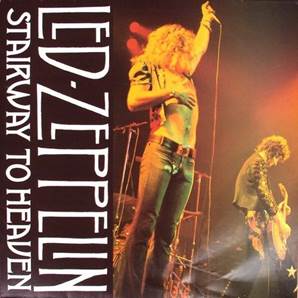
Led Zeppelin’s 1970 Stairway to Heaven (released in 1971) puts a soft misogynist spin on a woman determined to buy her way in.
There’s a lady who’s sure all that glitters is gold And she’s buying a stairway to Heaven When she gets there she knows, if the stores are all closed With a word she can get what she came for…
Well sure, but does this lady, Led Zeppelin makes no bones about it, have a chance of getting in assuming she ‘gets there’?
There are a range of questions. Are there bodies? Not for the Greeks, just shadows in need of blood as we read in Homer, as Lucian mocks: one is stripped, no skin, no faces, men lose muscular and every worldly distinction and women their beauty. In the Judeo-Christian vision, we can ask about the resurrection of the body.
Maybe it’s easier to ask if angels are sexed (the heavenly ‘Kitzeh’ Vladimir Jankélévitch mentions does not exempt men, at least not, after Augustine’s City of God, for the theologians)? Alan Rickman demonstrates the glumly graphic case per contra as Metatron in Kevin Smith’s 1999, Dogma.
And Jankélévitch writes, provocatively, “Music of all the arts, is in the end the one most alien to eroticism.”[3]
Figure 5 Nikolai Rimsky-Korsakov, “The Legend of the Invisible City of Kitezh and the Maiden Fevroniya”
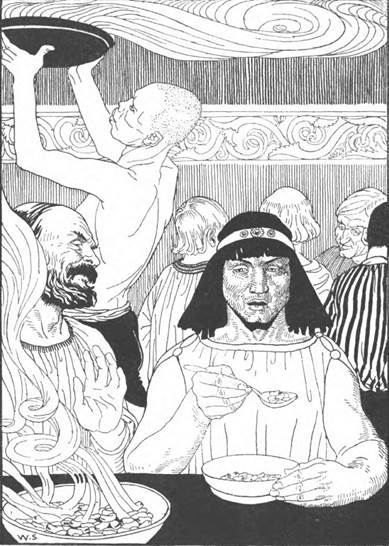
We know from Empedocles that the gods dine, Greek myth has them engaging in all manner of physical pursuits, sex, procreation, drinking, fighting and Lucian parodizes the idea of eating and the accoutrements of the afterlife in his discussion of the ‘Isle of Blest’ in his Alethe diegammata [True History], a tale apostrophized as false and thus ‘true’ qua flagged as false).[4]
In his Katharmoi, Empedocles tells us he has dined with the gods but we know, and it is Lucian, once again who satirically highlights the point, the gods dine on vapors, that would have to be without body unless incarnate in ontic material being (the great Christian achievement, as Archibald MacLeish teases in his 1958, Pulitzer Prize winning J.B., you get your body back[5]) — the Olympian Zeus excelled in this which quite puts a determinative spin on his metamorphoses: as an eagle, a swan, a shower of gold, which makes the matter of food and drink for the gods, their nectar and ambrosia more complicated than one might think.
Figure 6. William Strang. Lucian’s True History. 1894.
The Greeks might keep the flesh of their animal sacrifices for their human enjoyment, reserving the fat and the bones for the gods, so much smoke. And the Gods trade in smoke, in clouds, as the 7th century Pindar tells us in his second Pythian that Zeus created a phantom, Nephele in the likeness of Hera, to deceive Ixion, which worked, leading to bastard progeny, which same went off to mate with magnesian mares, thus the race of centaurs. Vapors will matter for all the gods can have of food and the mutability of divine form adds complexity.
If Lucifer dreams, as Milton and Goethe restore the sexual dimensionality Augustine’s more exacting theology had excluded, the question of women remains just to read the gospel: “At the resurrection people will neither marry nor be given in marriage; they will be like the angels in heaven.” (Matthew 22:30)
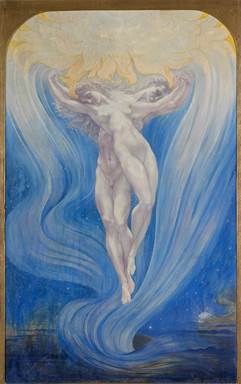
Once again: are angels sexed? Milton says so: his Lucifer is a fallen son of the divine and Milton’s angels are sexually active, as I am assured by my friend and colleague, the Milton and Swift scholar Frank Boyle. Other scholars review the evocative, basar achad, One Flesh.[6]
Figure 7 Jean Delville (1867-1953) L’Union des âmes. 1900. Musée d‘Ixelles, Brussels.
The broader question, beyond the angels, persists.
Like the rich young man who comes to ask Jesus how to be perfect only to learn that for this, beyond keeping commandments, he is to sell all he has, then, there is a list, he is give the proceeds to the poor, and then he is follow Jesus, none of which he, being a rich man, is prepared to do.
The issue is complicated: the current genocide in Gaza shows the dedicated persistence of claims to religious superiority and similarly the question of women remains.
Ernest McClain, the Brooklyn College arithmetical musicologist, counts the numbers: 2 is the first female number, three is the first male number, to muse that in Christ there is neither Greek or Jew, slave or freeman, male or female (Galatians 3:28). Satan can use Eve to undermine Adam, undermining Eve would scarcely count but it is also through woman, through Mary as handmaid, that deity can redeem the world. Jesus is the son of man solely, that is exclusively of the lineage of David, solely through Mary.[7]
When it comes to heaven, we think all kinds of things: Rainbow bridge reunions; perfect redemptions, a body at its perfect age, perfected, incorruptible, form.
But the problem of heaven for women remains a thing. Even Eric Clapton and Will Jennings, writing after the death of Clapton’s young son, Conor, ask about recognition in their 1991 Tears in Heaven.
Maybe it’s true of everyone, bodiless, transposed to the beyond, ‘would it feel the same?’ Still Clapton is sure: there’ll be no tears.
And we hear about the virgins promised to martyrs, dissonant: just what is promised to women? And we hear that women can get into heaven by the sheer force, intersession, of their sons.
But we don’t believe that. How could we believe that? But is there sex? Well, there’s no procreation — Augustine has thought it through — so no lust. But is there gender? Perhaps decoratively so.
I’ve argued that the women excluded from the Orphic mysteries were less than sanguine about this exclusion if misogynistic readings turn this into garden-variety personal resentment on the part of the maenads, competing with the memory of Orpheus’ dead wife (is this so?), certainly in contest with one other, eventually tearing him in their anger limb from limb, a compensatory backwash, the vision of selection and loss haunting in (and haunting rock motorcycle ballads), the 1965 Shangri-Las, Leader of the Pack, or of a Leslie Goehr kind, her 1963 hit, It’s My Party or, written by Beverly Ross and Edna Lewis, her 1963: It’s Judy’s Turn to Cry.
The theme of this section on women in heaven is also the theme of paradise, the afterlife, the beyond and what it says about, or how it bears on, this earthly life, here and now. Phil Collins tries to make this point in his 1989, Another Day in Paradise.
[5] Dylan met MacLeish, at his invitation, for the sake of an apocalyptic play and he recounts the experience in Dylan, Chronicle, 207ff.
[6] Turner 1987 and Chaplin 2001 as well as Raymond 2010 and de Gruy 2012.
[7] See on this last theme, on woman and redemption, Babich, The Hallelujah Effect: Music, Performance Practice and Technology (London: Routledge Paper: 2016 [2013]).
Babette Babich, Professor of Philosophy at Fordham University in New York City, has wide-ranging interests, with a special focus on the philosophy of science, philosophy of technology, including digital media, as well as art and aesthetics, conceived from the perspective of (classical) continental philosophy. She is interested in themes associated with classics, museum studies, political philosophy, and such.
View more posts
One thought on “‘Will You Know My Name?’”
Through the years I have been intrigued by some insisting on a Heaven on Earth. And then a few years ago hear a song that fuses Climate Changes in some near Future with a plaea for evine intervention. On YouTube you will fin The Gathering Live 2005 ‘A Sound Relief. Listen to ‘Golden Groans’….Moving forwar 20 years, on KEXP Live the singer songwriter Alice Phoebe Lou sings a song called ‘Hallo’ about a sort of Limbo that is Heaven (Milton, I think Milton would concur, for the act of self-annihilation. The mundanity is startling. Back to Earth again an the Gathering song ‘Leaves is the only pop song I’ve heard that at the start, describes in detail cold and impersonal love-making. As if an angel or alien had passed a line to become involved briefly with our species – (re; The Gathering live 2007 A Severe Noise.) Music can trigger all sorts of emotions. But also can interest us intellectually. Erotic! Yes, memory an recognition can touch the erotic mind.



Through the years I have been intrigued by some insisting on a Heaven on Earth. And then a few years ago hear a song that fuses Climate Changes in some near Future with a plaea for evine intervention. On YouTube you will fin The Gathering Live 2005 ‘A Sound Relief. Listen to ‘Golden Groans’….Moving forwar 20 years, on KEXP Live the singer songwriter Alice Phoebe Lou sings a song called ‘Hallo’ about a sort of Limbo that is Heaven (Milton, I think Milton would concur, for the act of self-annihilation. The mundanity is startling. Back to Earth again an the Gathering song ‘Leaves is the only pop song I’ve heard that at the start, describes in detail cold and impersonal love-making. As if an angel or alien had passed a line to become involved briefly with our species – (re; The Gathering live 2007 A Severe Noise.) Music can trigger all sorts of emotions. But also can interest us intellectually. Erotic! Yes, memory an recognition can touch the erotic mind.