
I end with Nietzsche on music and what for him mattered as the democratic art of tragedy, as in antiquity, this involved everyone — without exception.
The communal point works in some Neil Diamond concerts:
pack up the babies, grab the old ladies, ev’ryone goes, ‘cause everyone knows.
Brother Love’s Travelling Salvation Show [1] describes a ‘revival’ meeting in Jackson, Mississippi, 1967, as Diamond tells us on the BBC, live in 1971, and as Diamond explains on the Johnny Cash Show,[2] Take my hand, dear God, walk with me this day, In my heart I know, I will never stray, this is the preacher’s sermon, Diamond’s Halle-, Hallelujah.
Amen, brother.
You can see the revival style in some more recent Neil Diamond concerts. Thus, live in 2008, the singer, so it may be argued, and he earlier tells us so, he runs as a revival, masterfully, the admiration is in the song he writes, bringing the crowd to sing along, with words, like the old red bouncing ball of a television cartoon, as Diamond urges: ‘Sing it now’ in his Sweet Caroline.
One can compare this with the younger Neil Diamond, same song, no guitar, on the Ed Sullivan show.
For a different century, Nietzsche asks
What would we understand of the text of a Mass by Palestrina, a Bach Cantata, a Handel Oratorio, if we did not somehow ourselves sing along? Only for those ‚singing with [den Mitsingenden] is there a lyric, is there voice music.[3]
Nietzsche, Nachlaß
McClain emphasizes the sex of the virgins singing as determinedly “male virgins”
When Solomon’s temple eventually is dedicated the perfect unisons of David’s 288 professional singers (“sons of Asaph”) accompanied by 120 “priests with trumpets” raise such a “cloud of glory that the priests could not stand to minister.” When New Jerusalem descends from the clouds at the end of Revelation these forces are dwarfed by a chorus of 144,000 male virgins “singing a new song” reserved for them, accompanied by 24 angelic harpists. These integers define pentatonic and heptatonic modal tuning systems…[4]

Using what he calls “Satan’s Comma,” McClain illustrates what he calls “the sins of approximation forgiven within the septimal comma 35:49 :: 50:10.[5]

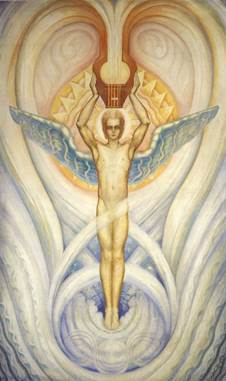
This would be the force, the image could hardly be more stylized, in terms of design, of the Belgian symbolist artist, Jean Delville’s Angel of Music.
Maybe it doesn’t matter (and transcendence has a powerful brief for things not mattering). Certainly, Nietzsche says, it doesn’t matter if the chorus singing Handel’s Oratorium understands the words, that is not their concern: they sing “from out of an inner drive, untroubled as to whether the word is comprehensible to those not singing along.”[6]
In a way this is what Jean-Luc Nancy means at the end of his small essay collection on Listening when he says that “it is not a hearer [auditeur], then, who listens, and it matters little whether or not he is musical.”[7]

For Nancy,
“Listening is musical when it is music that listens to itself. It returns to itself, it reminds itself of itself, and it feels itself as resonance itself.”[8]
Of course Nancy echoes, quite as Husserl and Heidegger and Anders all echo, Augustine on music and singing — this is the relation with time and perhaps thereby we might think the relation with paradise— “Music is the art of making the outside of time return to every time, making return to every moment the beginning that listens to itself beginning and beginning again.”[9] In this way, music, as Jankélévitch writes, “makes every listener into a poet.”[10]
One does not have to follow all the classical (and very French: Debussy, Fauré, Satie) nuances of Jankélévitch’s variegated paean to the ‘ineffable’ in music, to recognize an air guitar, lovers, together or lonely, singing in a car.
But the question I began by asking remains unanswered: are there women in paradise? Monotonotheists say yes, post-classically, variously, depending on how they read their theology. In the mystery tradition of Greek antiquity, given death and rebirth, things would be different.
Barred by Orpheus himself from participating in the Orphic cult in antiquity, women would thus make the transition from life to afterlife without access to his Orphic mystery initiation.[11] We are told women had their own separate rituals; what did this offer? If this exceeds the current discussion one would need to identify these rituals and to date them,[12] differentiating Eleusian mysteries, Demeter and other cults. But separate cults, like separate roles, are exclusions. Perhaps their famed fury had less to do with scorn than a protest against eternal death/rebirth.
The plaintive question in the exchange in “I Would Do Anything for Love”, shows Steinman’s Meat Loaf (still) channelling Orpheus listening to his lady — ‘Will you get me right out of this god forsaken town?’ For a man, that’d be easy: ‘O I can do that’. If the reference to the ‘god-forsaken’ is a gnostic reference to life on earth, exclusion attends the complicated theological question of the place of women in paradise. To the question, are there women in paradise there are different answers in ancient as in contemporary religious culture.
Is there sex (or gender) as such in paradise? What about God? Are angels sexed? The rapture, so McClain tells us, features ‘144,000 male virgins “singing a new song”’.[13]
Leonard Cohen seems to suppose that women are angelic in nature.[14] Must they, as Augustine implies, be transfigured as men?
Is being male key to being imago dei?
It’s complicated as Robert Plant’s lyrics remind us: “Sometimes all of our thoughts are misgiven.”
Before the song concludes, it softens, if after explaining that the piper is calling (this is redemptive “If we all call the tune Then the piper will lead us to reason”) and we hear, winding past the misogyny:
“Dear lady, can you hear the wind blow? And did you know / Your stairway lies on the whispering wind?”
RIP Dolly Parton (1946-2026)
Postscript: On Dolly Parton’s ‘Cover’ of Stairway to Heaven
“When Dolly Parton approached Robert Plant for permission to record her version of Stairway to Heaven, she reportedly worried about how he would react. Instead, Plant’s response was wonderfully simple: ‘Of course you can, you’re Dolly Parton.’ And somehow, that feels like the perfect answer. …Sometimes, a legend recognizing another legend is all the permission you need.”
— @Sunflower15025, Twitter 1 Sept 2026
[1] Years later, Diamond’s ‘Hot August night,’ I am inclined to argue, influences Jim Steinman’s Meat Loaf vehicle, You took the Words Right Out of My Mouth, set in parentheses: (Hot Summer Night).
[2] I thank Frania Shelley-Grielen for her post on Facebook if my reading differs, cf. on Nietzsche and Beethoven (and voice) the last chapter of The Hallelujah Effect (London: Routledge, 2016 [paper]).
[3] Nietzsche, Kristische Studienausgabe. Giorgio Colli and Mazzino Montinari, eds., (Berlin: de Gruyter, 1980), Vol. 7, 369.
[4] Ernest McClain, “A Priestly View of Biblical Arithmetic” in: Babich, ed., Hermeneutic Philosophy of Science, van Gogh’s Eyes, and God (Dordrecht: Kluwer, 2002), 429-443, here: 430.
[5] McClain The Pythagorean Plato: Prelude to the Song Itself (York Beach, Maine: Nicolas Hays, 1978), 53.
[6] Nietzsche KSA 7, 369.
[7] Jean-Luc Nancy, Listening, Charlotte Mandell, trans. (New York: Fordham University Press. 2007), 67.
[8] Nancy, Listening, 67.
[9] Nancy, Listening, 67.
[10] Vladimir, Jankélévitch, Carolyn Abbate, trans. music and the ineffable (Princeton: Princeton University Press, [1961] 2003), 87.
[11] See on the importance of initiation, Alberto Bernabé “Orphics and Pythagoreans: The Greek Perspective” in: Gabriele Cornelli, Richard McKirahan, and Constantinos Macris, eds., On Pythagoreanism (Berlin: de Gruyter, 2913), 117-151.2013 and Bernabé and Ana Isabel Jiménez San Cristóbal. 2008. Instructions for the Netherworld: The Orphic Gold Tablets (Leiden: Brill, 2008).
[12] Nietzsche tells us that setting dates is the challenge for the historian. See Babich Nietzsches Antike, 2023.
[13] McClain 2002, 430.
[14] Babich 2014, 127.